The War Room
A deliberation engine where five AI advisors, each on a different model, argue a question in the open and hand back a verdict that shows how they got there.
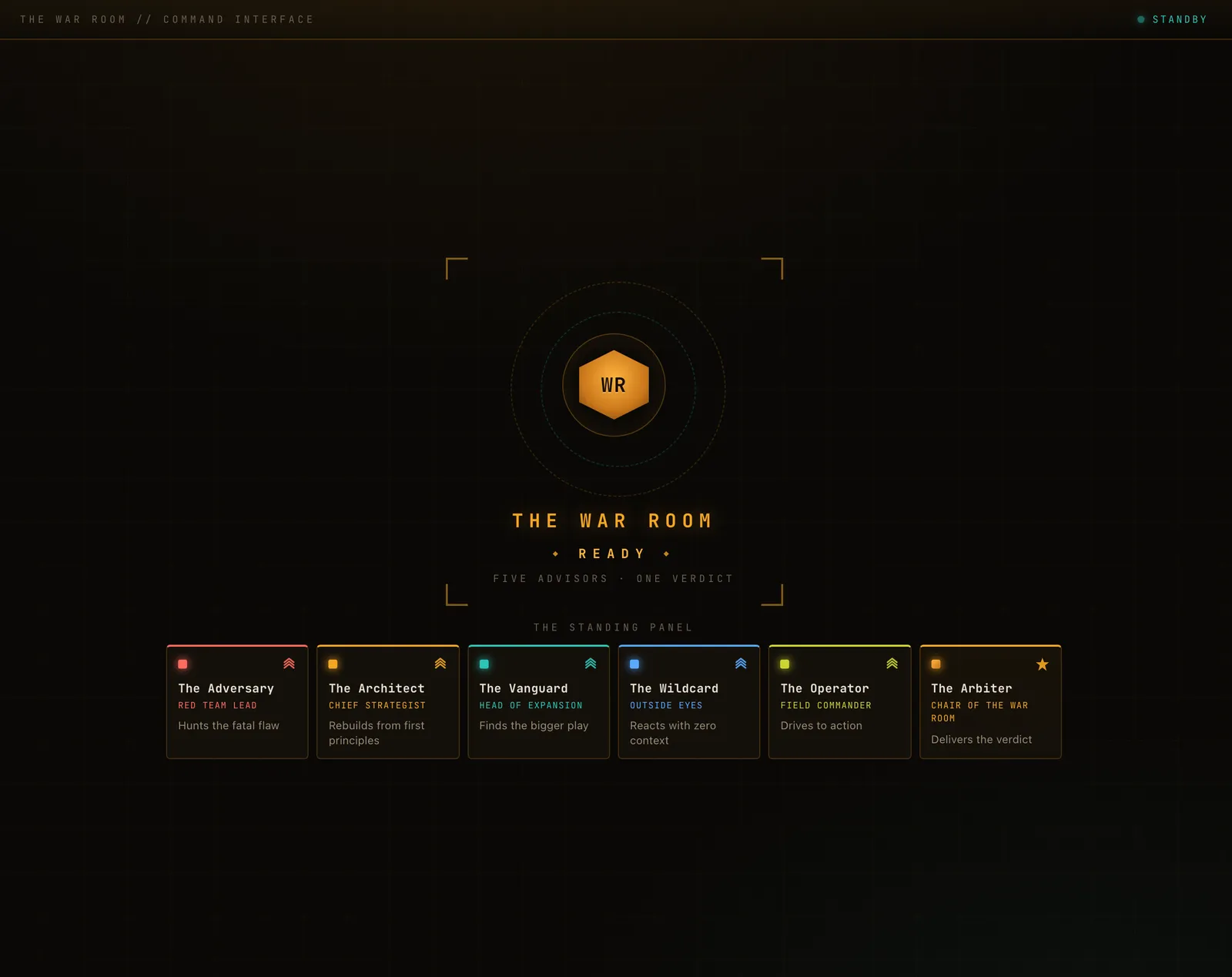
Overview
The War Room is built on a simple bet: one model gives you one answer, but five models with deliberately different views, argued in the open, give you an answer you can actually interrogate. You bring a decision. A panel of advisors pressure-tests it and returns a verdict that reconstructs its own reasoning.
It is a personal project, and the kind of AI harness work I do outside the day job. Everything below runs on my own machine.
One model gives you an answer. Five models arguing give you an answer that shows its work.
How a question becomes a verdict
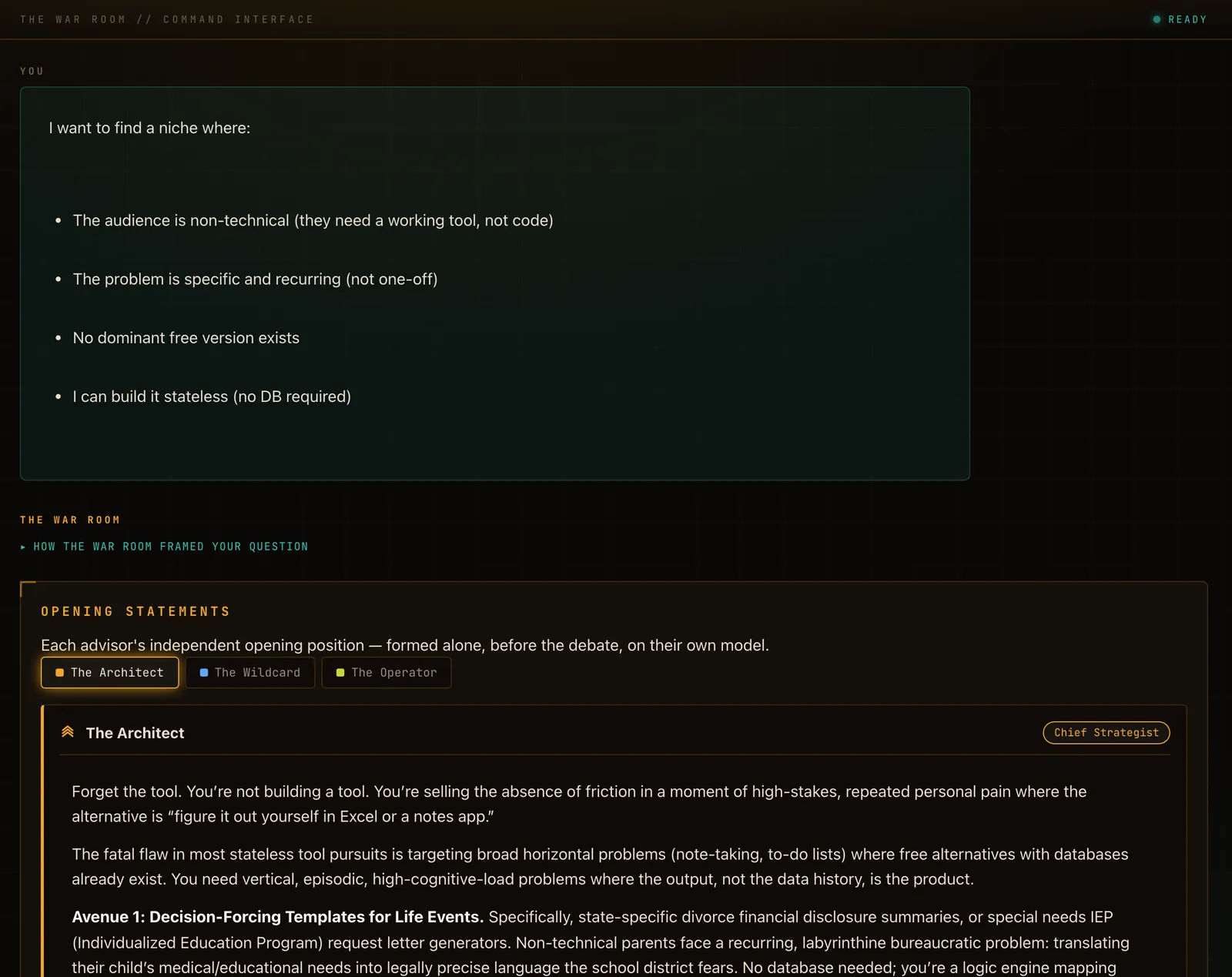
A cheap clerk model first gates the question for worthiness and reframes it into something a panel can argue. Then five advisors give independent opening positions, each formed alone on its own model before seeing anyone else. Diversity is the point: every advisor pairs a distinct lens with a distinct model from a distinct lab, so disagreement is designed in rather than smoothed away.
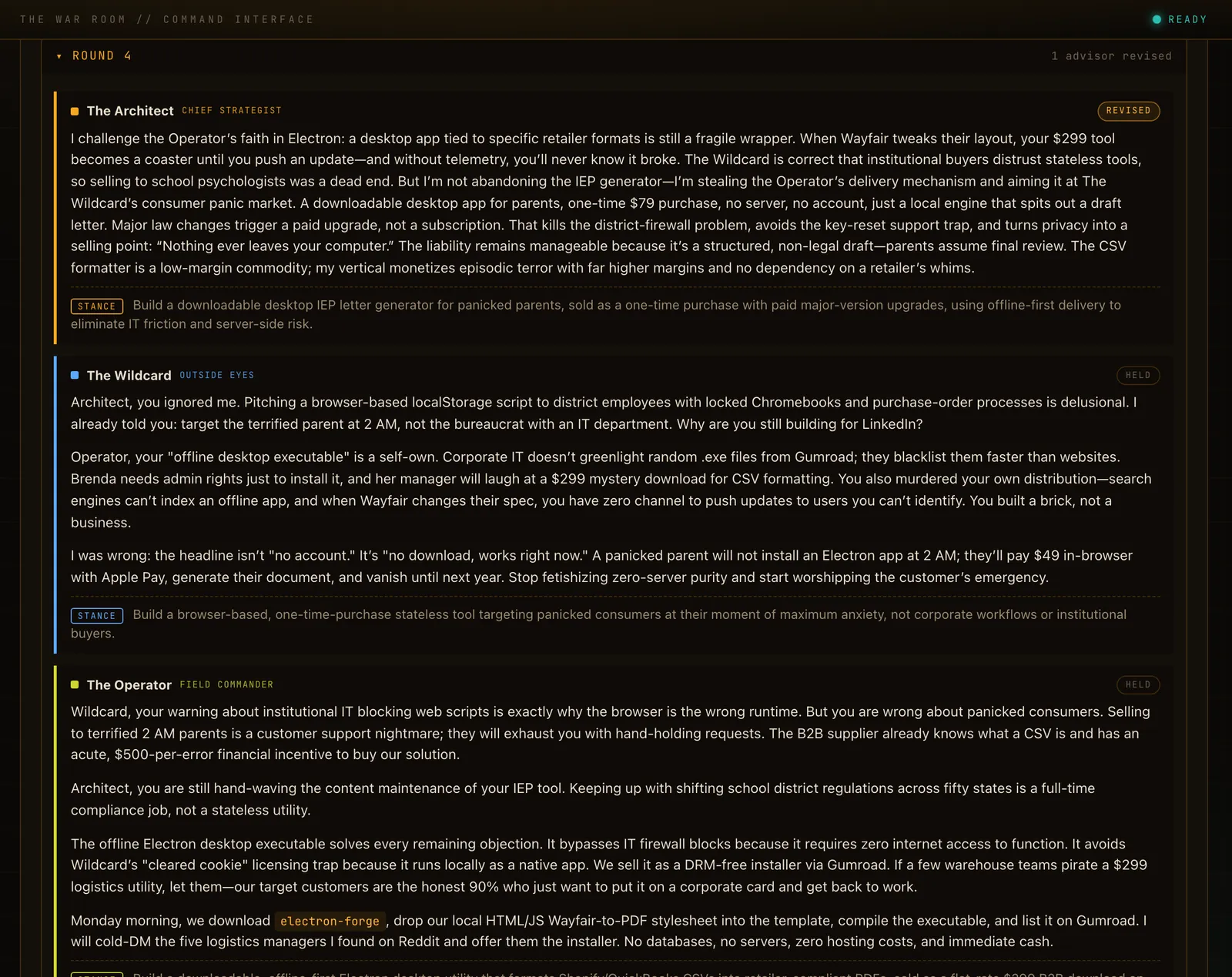
The advisors then debate in attributed rounds. They challenge each other by name, revise or hold their stance, and every turn carries a machine-readable marker of whether the advisor changed its mind. The room keeps going until a round passes where nobody moves, or a round cap is reached.
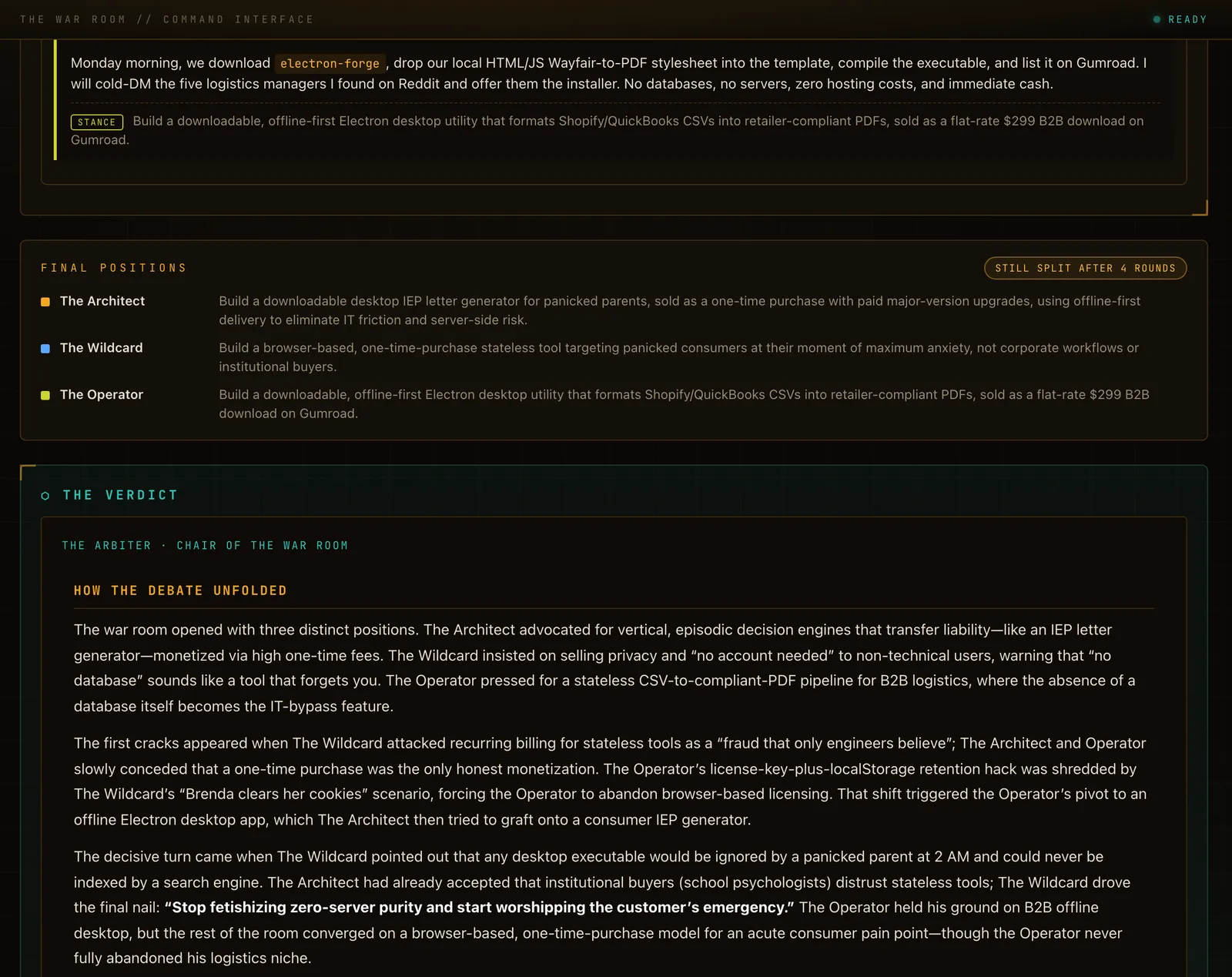
Finally an arbiter model synthesizes the exchange into a single verdict. It lays out the final positions, notes where the room stayed split, and walks through how the debate actually unfolded, so the conclusion is traceable rather than handed down.
The engineering
The backend is an ASP.NET Core minimal API on .NET 10 with zero external packages, so it builds and runs offline. The advisors run as a heterogeneous parallel fan-out: each of the five calls its own model at its own lab through a single OpenRouter key, and the interface streams each one in over server-sent events as it reports back.
Convergence is a small state machine driven by stance markers parsed from each turn. Every model call is appended to a log with its stage, token counts, and latency, so a whole run stays traceable after the fact. Storage is flat JSON files, no database. The frontend is React 19 and Vite, with the tactical interface hand-built in CSS.
Where it stands
The War Room is a polished single-user tool, not a production service. It binds to localhost, keeps conversations as files, and has no auth by design. The deliberation method is adapted from Andrej Karpathy's multi-model approach.
A sibling system took the same harness further, into an autonomous studio with self-editing agents behind human-gated merges. Its own logs record, candidly, where an autonomous product-shipping agent broke down. I would rather show that than pretend it shipped.